
How Xtreme Energy Drink Conquered Nepal: A Full Marketing Breakdown
Look at the Google Trends data for “xtreme energy drink” in Nepal over the past five years. For most of 2022 and 2023, the line sits close to zero. Then something shifts. By late 2024, it is climbing. Through 2025, it rises steeply. By early 2026, it hits 100 — the maximum index — a vertical spike that represents peak search interest.
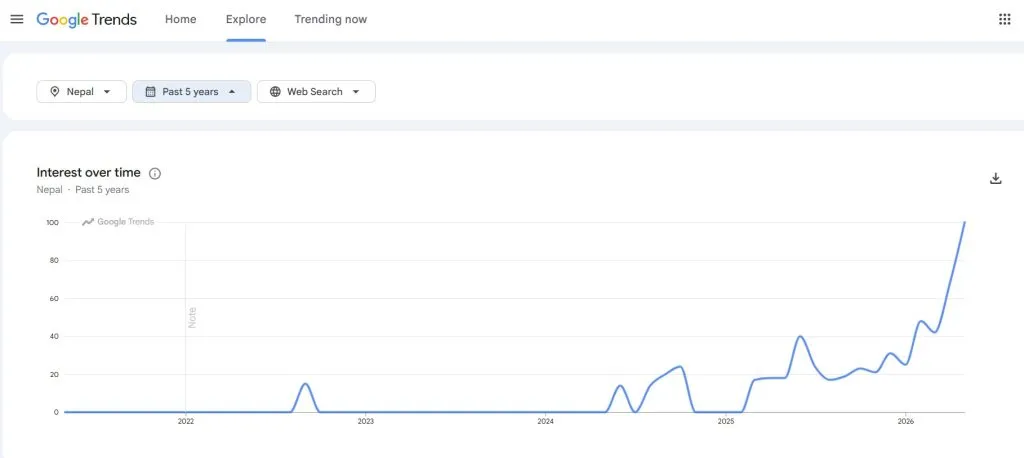
Screenshot of Google Trends for “xtreme energy drink”
That is not organic growth. That is a marketing machine switching on.
Xtreme Energy Drink — produced by Agro Thai Foods Pvt. Ltd. in Nepal — has executed one of the most aggressive, multi-channel, multi-touchpoint brand building campaigns Nepal’s FMCG sector has ever seen. From cold stores and tea spots across Kathmandu to the jerseys of Nepal’s national women’s cricket team, from TikTok campaigns to Truecaller ads, from Durbarmarg street festivals to the ICC Men’s T20 World Cup broadcast on national television — Xtreme has been everywhere, all at once.
As a growth strategist, I study brand launches and marketing campaigns in Nepal because they teach things that no international marketing blog ever will. Xtreme’s playbook is a masterclass in how to build a brand in Nepal’s specific market context — and in how to use a regulatory void as a competitive moat.
This is the full breakdown.
“Xtreme did not build a product and wait for the market to find it. It built a presence — in stadiums, on jerseys, in your feed, on your phone, at your local pasal — until refusing to recognise it became impossible.”
Table of Contents
- The Context: Why Nepal Was a Green Field for an Energy Drink Brand
- The Marketing Strategy: Every Channel, Simultaneously
- Layer 1 — Ground-Level Distribution and Visibility
- Layer 2 — Out-of-Home (OOH) and Street Presence
- Layer 3 — Sports Sponsorships: The Core Brand-Building Engine
- Nepal Premier League — Kathmandu Gorkhas Jersey (November 2025)
- National Women’s Cricket Team Jersey Sponsorship (January–February 2026)
- ICC Men’s T20 World Cup Broadcast Sponsorship (January 2026)
- Nepal Road Racing Championship — Xtreme Race (2025)
- Layer 4 — Digital Advertising: Google, Meta, and Truecaller
- Meta Ads (Facebook and Instagram)
- Google Ads
- Truecaller Ads
- Online Khabar and News Media Ad Breaks and Banners
- Layer 5 — TikTok: The Organic Amplifier
- Layer 6 — Community and CSR: The Samba Donation
- The T20 World Cup Fan Campaign — Consumer Activation Done Right
- Decoding the Xtreme Marketing Playbook
- What Every Nepal Marketer Should Learn From Xtreme
- The Google Trends Signal — What It Actually Means
- What Xtreme Has Not Yet Solved
- The Bigger Marketing Lesson for Nepal Brands
- Checkout services I offer:
- Further Reading
The Context: Why Nepal Was a Green Field for an Energy Drink Brand
To understand why Xtreme’s marketing worked, you first need to understand the market it entered.
The Red Bull Ban — and the Market It Shaped
In June 2019, the Nepal government banned the import of foreign energy drinks and other caffeine-mixed energy drinks, citing health concerns and trade deficit reduction as justification. The move was controversial — Indian traders called it a violation of international trade norms and threatened legal action — but it stood.
The practical effect was the removal of the most globally recognised energy drink brand from Nepal’s shelves. The energy drink category in Nepal did not disappear. The demand for caffeinated, youth-oriented beverages did not disappear. Red Bull’s brand equity in Nepal — built through years of global sports and lifestyle marketing that Nepali consumers had absorbed — did not disappear either.
What disappeared was the imported supply. And over the years that followed, domestically produced alternatives — including Xtreme by Agro Thai Foods — moved to fill that space.
It is worth being precise about the timeline here. Xtreme’s aggressive marketing surge — the cricket sponsorships, the TikTok campaigns, the digital ads — began in late 2025, roughly six years after the Red Bull ban. The Google Trends data confirms this: search interest for “xtreme energy drink” in Nepal was near zero through 2022 and 2023, only beginning to rise meaningfully in late 2024.
This means the Red Bull ban was not the direct trigger for Xtreme’s marketing push. What it did was shape the competitive landscape Xtreme entered — a market where the aspiration for a premium energy drink brand existed, the habit of consuming energy drinks was established, but the dominant imported brand was absent. Whether Xtreme was consciously designed to fill this gap or simply benefited from it, the structural opportunity was real. And when Xtreme finally decided to invest in marketing seriously, it entered a market that was primed and waiting.
The marketing lesson: Xtreme did not have to convince Nepal that energy drinks were desirable. That desire had been seeded by years of global Red Bull marketing that Nepali consumers had absorbed. Xtreme’s challenge was positioning itself as the legitimate, locally available answer to that desire. That is a very different — and strategically easier — marketing problem than building a category from scratch.
The Youth Demographic
Nepal has one of the youngest populations in South Asia. The 15–35 age demographic — exactly the core energy drink consumer — is large, digitally active, growing in urban areas, and deeply embedded in sports culture, particularly cricket. This is an audience primed for exactly the kind of brand Xtreme wanted to build: energetic, sport-associated, adventurous, aspirational.
Google Trends data: Searches for “xtreme energy drink” in Nepal were near zero through 2022 and most of 2023. The curve begins rising in late 2024, accelerates sharply through 2025, and hits the maximum interest index of 100 in early 2026 — coinciding exactly with the T20 World Cup sponsorship and women’s cricket jersey announcement.
The Marketing Strategy: Every Channel, Simultaneously
What separates Xtreme’s approach from most Nepal FMCG brand launches is the sheer breadth and simultaneity of channels. They did not start with one channel, prove it, and expand. They attacked from every direction at once — creating the impression of ubiquity that makes a brand feel established and dominant even when it is relatively new.
Layer 1 — Ground-Level Distribution and Visibility
The foundation of Xtreme’s marketing was not digital. It was physical.
Before any campaign could work, the product had to be visible at every relevant touchpoint where the target consumer spends time. Tea stalls (chiya pasals), cold stores, restaurants, sports venues, and convenience shops across Kathmandu and major cities. A consumer who sees an Xtreme ad on Facebook and then walks into their local pasal and cannot find it is a lost conversion. A consumer who sees the ad and immediately finds the can at the counter completes the loop.
This distribution-first approach is something most digital-native Nepal brands get wrong — they build digital presence before physical availability, then wonder why their campaigns generate awareness without sales. Xtreme understood that in Nepal’s FMCG category, the pasal shelf is the final conversion point. Digital marketing drives you to the shelf. The shelf closes the sale.
Layer 2 — Out-of-Home (OOH) and Street Presence
Xtreme invested significantly in outdoor visibility — billboards, hoardings, and event branding across Kathmandu. The Durbarmarg Street Festival, one of Kathmandu’s most attended annual events that draws thousands of visitors along Nepal’s most iconic commercial street, featured Xtreme Energy Drink prominently as a sponsor.
Events like Durbarmarg Street Festival serve a specific marketing purpose beyond mere exposure. They associate the brand with the energy, excitement, and social atmosphere of a public gathering — exactly the emotional territory an energy drink brand wants to own. You do not just see Xtreme at the festival. You consume Xtreme while you are having fun. That pairing of product with positive experience is the foundation of effective FMCG event marketing.
Layer 3 — Sports Sponsorships: The Core Brand-Building Engine
If Xtreme had a single strategic priority in 2025 and 2026, it was sports. Specifically, cricket — Nepal’s most emotionally invested sport with a rapidly expanding professional ecosystem.
The sponsorship moves were sequenced with impressive strategic logic:
Nepal Premier League — Kathmandu Gorkhas Jersey (November 2025)
Xtreme signed as the official beverage partner of Kathmandu Gorkhas for the NPL season starting November 17, 2025. The Gorkhas’ jersey featured the Xtreme logo on the back throughout the tournament. The signing was covered by The Kathmandu Post, generating earned media alongside the paid sponsorship.
The NPL is Nepal’s premier franchise cricket competition. It is broadcasted on television, covered by national media, discussed on social media, and watched passionately by Nepal’s cricket-loving population. A jersey sponsorship in the NPL is not just brand placement — it is an association with national pride at a moment of high emotional engagement.
National Women’s Cricket Team Jersey Sponsorship (January–February 2026)
Xtreme signed a two-year jersey sponsorship agreement with the Cricket Association of Nepal (CAN) on January 19, 2026 — placing the Xtreme logo on the national women’s cricket team jersey. The new jersey was unveiled at an official ceremony attended by the Acting Member Secretary of the National Sports Council and CAN Secretary Paras Khadka.
This move was strategically significant for multiple reasons. First, the national women’s team operates at an entirely different visibility level than a franchise team — it represents Nepal internationally, carries the national flag, and generates pride-based emotional engagement from a broader demographic than franchise cricket. Second, a two-year commitment signals long-term brand investment rather than a one-time sponsorship of convenience. Third, the association with women’s cricket positions Xtreme as a brand that backs Nepal’s emerging sports talent across genders — an increasingly important brand value for younger Nepali consumers.
ICC Men’s T20 World Cup Broadcast Sponsorship (January 2026)
The most visible Xtreme sponsorship of the entire campaign. Xtreme Energy Drinks became the main sponsor for Kantipur Max HD Television’s live broadcast of the ICC Men’s T20 World Cup — the first time any Nepali television channel had broadcast the tournament live. All 55 matches were broadcast, with English commentary on Kantipur Max and Nepali commentary on Kantipur Max-2.
Pre-match and post-match programmes featuring cricket experts were produced in coordination with Xtreme, embedding the brand into hours of live cricket content. For a Nepal audience that had never watched the T20 World Cup live on national television, this was a historic moment — and Xtreme’s logo and name were present throughout every minute of it.
Xtreme also announced that it would distribute 2,000 Nepal cricket team jerseys free of cost at Wankhede Stadium in Mumbai for Nepali supporters travelling to watch Nepal’s T20 World Cup matches live. This activation extended brand presence beyond Nepal’s borders and into the international cricket community.
“Xtreme did not just sponsor cricket. It sponsored Nepal’s cricket moment — the first live T20 World Cup broadcast in Nepali history. That is not a media buy. That is a permanent place in a cultural memory.”
Nepal Road Racing Championship — Xtreme Race (2025)
Beyond cricket, Xtreme activated in motorsports — sponsoring the Xtreme Race at the Nepal Road Racing Championship. The event aligned perfectly with the brand’s core positioning around speed, adrenaline, and extreme performance. TikTok content from the event — featuring race footage and the “Xtreme Race” branding — generated significant organic engagement with Nepal’s motorsports community.
Layer 4 — Digital Advertising: Google, Meta, and Truecaller
Alongside its sports and OOH presence, Xtreme ran aggressive digital advertising across multiple platforms simultaneously.
Meta Ads (Facebook and Instagram)
Xtreme ran targeted Facebook and Instagram campaigns reaching Nepal’s target demographic with energy, adventure, and sports-themed creative. The campaigns ran alongside organic content featuring UGC from events, athlete endorsements, and cricket-related content — creating a reinforcing loop between paid reach and organic engagement.
Google Ads
Display campaigns ensured Xtreme captured intent-based searches for energy drinks in Nepal. As the Google Trends data shows, search volume for “xtreme energy drink” was growing rapidly through 2025 — Google Ads allowed Xtreme to capture that rising intent at the exact moment users were actively looking.
Truecaller Ads
One of the more distinctive digital choices in Xtreme’s mix. Truecaller — the caller ID and spam detection app — is one of the most widely used apps in Nepal, where it is used to identify unknown callers. Truecaller ads appear at the incoming call screen, giving advertisers a moment of undivided attention from a user who has just picked up their phone. It is an unconventional placement but a smart one for a brand trying to reach mobile-first Nepali consumers in a moment of genuine attention.
Online Khabar and News Media Ad Breaks and Banners
Xtreme placed video ads in the ad breaks of Online Khabar — one of Nepal’s most widely read digital news platforms, known particularly for its video news content. This placement was strategically intelligent: Online Khabar’s audience skews toward urban, digitally active Nepali adults who consume news online rather than through traditional television. Running ad breaks in video news content puts Xtreme in the same viewing session as content that already has the audience’s full attention. Beside Online Khabar, Xtreme banner ads can be seen on various other digital news media websites.
Layer 5 — TikTok: The Organic Amplifier
Xtreme’s TikTok strategy deserves specific attention because it operated differently from its paid digital channels. While Meta and Google Ads were paid reach plays, TikTok functioned as an organic content and community engine.
The brand ran a dedicated TikTok campaign in April 2026, covered by eKantipur’s market section, focused on user-generated content and adventure-themed video. The TikTok content strategy was built around Xtreme’s brand positioning — adventure, extreme sports, energy, youth culture — using hashtags like #XtremeEnergy, #FeelTheRush, and #UnleashThePower to build a content ecosystem around the brand identity.
The Kathmandu Gorkhas NPL talent hunt — “Picking up Xtreme talents from all over Nepal” — was one of the most shared TikTok activations, generating content from across the country as cricket enthusiasts participated and shared their involvement. User-generated content from real participants is infinitely more credible than branded content — and it costs a fraction of equivalent paid reach.
Layer 6 — Community and CSR: The Samba Donation
One of the most emotionally resonant Xtreme marketing moments was the donation of NPR 5 lakh for Samba’s medical treatment. Samba — a well-known figure in Nepal’s sports community — required significant financial support for healthcare, and Xtreme stepped in publicly.
In Nepal’s market, CSR and community giving are not just ethical activities — they are powerful trust signals. A brand that visibly supports a community member in need earns a depth of goodwill that no advertising budget can replicate. This kind of gesture is shared organically, discussed in communities, and remembered long after any specific campaign has ended. It humanises the brand beyond its commercial activities.
The T20 World Cup Fan Campaign — Consumer Activation Done Right
One of Xtreme’s most complete campaign executions was the T20 World Cup Fan Scheme announced in January 2026, run jointly with sibling brand Max Tiger Energy Drink under parent company Agro Thai Foods.
The mechanics were elegantly simple: purchase Xtreme or Max Tiger Energy Drink, post a photo or video on Facebook or Instagram using the campaign hashtags (#T20XtremeEnergydrink), and enter to win a four-day trip to Mumbai to watch Nepal play in the T20 World Cup live at Wankhede Stadium.
40 total winners were selected — 15 through events organised in 15 major cities across Nepal (physical activation with national reach), and 25 through social media participation (digital activation with national reach). The prize — watching Nepal play cricket internationally — was perfectly aligned with the heightened national pride around Nepal’s T20 World Cup participation.
This campaign achieved multiple marketing objectives simultaneously:
-
Sales activation: Purchase required to enter — directly tied to product trial and repeat purchase
-
Social proof generation: Thousands of consumers posting with brand hashtags created an organic content wave across Facebook and Instagram
-
Brand association: The prize tied Xtreme permanently to Nepal’s T20 World Cup moment in participants’ memories
-
National reach: 15-city physical events ensured the campaign reached beyond Kathmandu into smaller urban markets
-
User-generated content: Consumer posts provided authentic, high-volume branded content at zero content production cost
Xtreme did not stop at cricket. With the FIFA World Cup 2026 approaching, the brand launched another consumer activation campaign — this time tying their product directly to football fever. The “Scan Ma Sun” (Scan for Gold) campaign, covered by Online Khabar, invited customers to scan a QR code printed on every Xtreme can, register their details, and enter a lucky draw. Three winners receive a solid gold football — sunauko baal — as the prize. The campaign runs through the entire FIFA World Cup 2026 match period.
The mechanics are deliberately simple and deeply tied to the purchase moment — the QR code is on the can itself, which means every customer who buys a can has an instant reason to engage digitally. It is a textbook purchase-to-digital activation: the physical product becomes the entry point to a digital campaign, generating consumer data, app or social media engagement, and brand association with the world’s biggest sporting event simultaneously. And the prize — a golden ball during the Football World Cup — is one of those ideas that is so on-brand and so culturally resonant that it generates its own organic social sharing.
Decoding the Xtreme Marketing Playbook
Stepping back from the individual activations, the coherent strategic logic of Xtreme’s approach becomes clear. Every element maps to one of four objectives:
| Marketing Layer | Strategic Objective | Nepal-Specific Rationale |
|---|---|---|
| Distribution (pasals, cold stores, restaurants) | Availability and trial | In Nepal’s FMCG market, the pasal shelf is the final conversion point. Digital drives to shelf. Shelf closes the sale. |
| Sports sponsorships (NPL, national team, T20 WC) | Brand association and emotional equity | Cricket is Nepal’s highest-engagement sport. Association with cricket = association with national pride. |
| OOH and events (Durbarmarg, motorsports, new year events) | Physical presence and brand recall | High-footfall events create product-fun pairing. OOH creates frequency and recall in Nepal’s urban centres. |
| Digital (Meta, Google, Truecaller, Online Khabar) | Targeted reach and intent capture | Multi-platform digital ensures brand reaches Nepal’s mobile-first youth across every digital touchpoint. |
| TikTok (organic + UGC campaigns) | Community building and content amplification | TikTok’s algorithm gives Nepali brands extraordinary organic reach among under-30 audiences at near-zero cost. |
| CSR (Samba donation) | Trust and community goodwill | Nepali consumers reward community-minded brands. CSR generates earned media and organic sharing. |
| Consumer activation (T20 fan scheme) | Purchase incentive and social proof generation | Purchase-tied campaigns drive trial while UGC creates social proof at scale. |
What Every Nepal Marketer Should Learn From Xtreme
1. Ubiquity is a strategy
Xtreme did not choose between sports sponsorship and digital ads or between OOH and social media. It ran all of them simultaneously. The psychological impact of seeing a brand across multiple unrelated contexts — on the cricket jersey, on your Facebook feed, on a billboard on Durbar Marg, in the Truecaller screen when your phone rings — creates a perception of market dominance that any single channel cannot produce. In Nepal’s market, where brand loyalty is still being established across many categories, ubiquity is a form of authority.
Pushkar Sharma, one of Nepal’s well-known marketing voices, put it precisely in a Facebook video when observing Xtreme’s campaign: “Xtreme Energy Drink has taken this seriously — be in the mind and be easy to find.”
That single sentence captures the entire dual mandate of FMCG brand building. Be in the mind is the awareness job — sports sponsorships, TikTok content, digital ads, OOH, news media placements. Be easy to find is the distribution job — the pasal shelf, the cold store counter, the restaurant fridge. Xtreme worked both levers at the same time. Most Nepal brands work only one — and wonder why the other is not producing results.
2. Find the cultural moment and own it
The T20 World Cup broadcast was Nepal’s first live international cricket tournament on national television. That was a cultural moment — the kind that gets remembered, talked about, and associated with brands for years. Xtreme was the main sponsor. When Nepali cricket fans remember watching their team at the World Cup for the first time on national TV, they will remember Xtreme. That is brand equity that no amount of product advertising can buy.
3. The regulatory landscape shapes your market — understand it
The 2019 Red Bull ban did not directly cause Xtreme’s rise — the timeline does not support that. But it did shape the market Xtreme eventually entered. Understanding the regulatory environment of your category is as important as understanding your customer. What government policies, import restrictions, or licensing realities are quietly shaping demand in your market? Any Nepal FMCG or consumer brand should be mapping these forces before they build their go-to-market strategy.
4. Distribution before awareness
Building awareness for a product that people cannot find is one of the most expensive mistakes in FMCG marketing. Xtreme built its distribution network — pasals, cold stores, restaurants — before or alongside its awareness campaigns. The consumer who sees the ad and finds the can at the counter converts. The consumer who sees the ad and cannot find the product becomes frustrated and forgets. Distribution is marketing infrastructure, not just a supply chain function.
5. TikTok is Nepal’s most underused brand-building tool
Xtreme’s TikTok presence — combining organic adventure content, event coverage, and UGC campaigns — demonstrates what the platform can do for Nepal consumer brands. The algorithm’s willingness to show content from new accounts to large audiences is a structural advantage that no other platform currently offers in Nepal. The brands that build genuine TikTok communities now will be very difficult to displace later.
6. Community investment builds trust that advertising cannot buy
The Samba donation and the willingness to be visible in local communities is not just good ethics — it is good strategy in Nepal’s market. Nepali consumers have a strong collective identity. A brand that is seen supporting a community member in need becomes part of that community. That emotional connection is more durable than any campaign.
The Google Trends Signal — What It Actually Means
Return to that Google Trends chart for a moment. The steep rise from near-zero to index 100 between 2024 and early 2026 is not just evidence that more people are searching for Xtreme. It is evidence that the marketing campaign worked.
Search interest is a lagging indicator of brand awareness. People do not search for brands they do not know exist. The rising search curve means that Xtreme’s multi-channel marketing campaign — the cricket sponsorships, the TikTok campaigns, the billboard presence, the digital ads — successfully drove awareness at scale into a population that had little prior exposure to the brand.
The spike in early 2026 — coinciding with the T20 World Cup broadcast, the women’s team jersey announcement, and the fan scheme campaign — is the visible signature of a marketing machine firing on all cylinders simultaneously.
What Xtreme Has Not Yet Solved
A fair analysis acknowledges the limitations alongside the strengths.
Awareness and availability are two different things — and Xtreme’s distribution outside the Kathmandu Valley and major cities is not yet as strong as its urban presence. The Google Trends data reflects predominantly urban search behaviour. The question of whether Xtreme has built meaningful brand presence in Nepal’s smaller cities, hill towns, and Terai districts is still open.
Brand association through sports sponsorship is powerful but expensive and non-compounding. Jersey logos and broadcast sponsorships are rented visibility — when the contract ends, the visibility ends. Xtreme will need to build the kind of organic brand community — through content, loyalty programmes, and consistent product experience — that continues to compound after any individual sponsorship expires.
The energy drink category in Nepal also carries health perception challenges. As Nepal’s urban consumer base becomes more health-conscious, the “vitalize body and mind” positioning will need to evolve or be complemented by messaging around product quality, ingredients, and responsible consumption — a challenge Red Bull navigated globally over two decades.
The Bigger Marketing Lesson for Nepal Brands
Xtreme’s story is not really about energy drinks. It is about what happens when a Nepal brand takes marketing seriously — building a multi-channel strategy, investing in cultural moments, combining physical and digital presence, and committing to consistent brand positioning across every touchpoint.
Most Nepal brands are still doing one thing — posting on Facebook, or running a single billboard, or doing a one-time influencer campaign — and then wondering why the needle doesn’t move. Xtreme did everything at once. It accepted that brand building is expensive and compounding — that the first NPL sponsorship makes the women’s team jersey sponsorship more valuable, which makes the T20 World Cup broadcast sponsorship more valuable, which makes the next activation even more valuable.
That is what a real brand marketing system looks like.
Building a brand in Nepal and want to think through your marketing strategy?
I work with Nepal businesses and startups to build full-funnel marketing strategies — from positioning and channel selection to campaign execution and measurement. If you want to think through what Xtreme did and how to apply it to your own brand, let’s talk.
Talk to Bimal about your marketing strategy
Checkout services I offer:
Further Reading
-
Go-to-Market Strategy for Nepali Startups: The Complete Founder’s Playbook
-
App Growth Strategy for Nepal — How to Get Your First 10,000 Downloads