
How I Built a Career as Nepal's Top Digital Marketing Strategist — My 10-Year Journey
Nobody starts a career in digital marketing in Nepal with a clear plan. There is no textbook, no established career ladder, and in 2015 there was barely an industry to speak of. You figure it out as you go — by curiosity, by experimentation, by failure, and occasionally by stumbling into something that works.
This is my honest story. Not the polished LinkedIn version. The real one — with the detours, the abandoned projects, the near-quits, and the moments that actually changed everything.
Ten years later I am the Head of Growth and Marketing at Trip Turbo — Nepal’s #1 travel app with 500,000+ downloads. I have built my personal brand at bimalrp.com. I have worked with 20+ Nepal brands across travel, NGOs, eCommerce, and startups. And I am writing this because the path I took — messy, unplanned, and entirely self-taught — is more replicable than most people think.
“I did not choose digital marketing as a career. I got pulled into it by curiosity, kept going because it worked, and eventually realised I had built something I could not have planned.”
Chapter 1 — The Meme Page, the Movies, and the First Proof That This Was Real (2015–2016)
I was in my late plus two when digital marketing found me. I had always been fascinated by technology — gadgets, the internet, how digital things worked. That curiosity made me more digitally active than most people my age in Nepal at the time.
In the early days of my bachelor’s I built a following on social media through punchy, sharp posts. That visibility led to an invitation that changed things: I was asked to join Nepal’s largest meme page at the time as a content creator.
For almost two years I wrote humorous content for a page with hundreds of thousands of followers. And I noticed something most people would have dismissed as noise: the public reactions, the comment section debates, the outrage and the laughter — all of it was teaching me in real time about what makes content spread, what makes people stop scrolling, and how an online audience actually behaves.
Then something even more interesting happened. A few Nepali movies approached the page for paid promotions — probably the first time influencer marketing happened on social media in Nepal in any organised way. I watched it happen from the inside and thought: there is real money in this if done right.
Simultaneously I was teaching myself everything I could find about making money online. I built websites on Blogger, learned how AdSense worked, and started earning small amounts from display advertising and Facebook Instant Articles. These were not significant amounts. But they were proof of concept — the internet could pay you now, if you understood how the pieces fit together.
The lesson I did not know I was learning: Understanding audience psychology is more valuable than understanding any single marketing tool. Two years of making content for a massive audience taught me more about what moves people than any course could have.
Chapter 2 — First Real Client, First Real Win: NIFF in 2017, Still in College
While I was still in college — 2017 — I got my first real professional digital marketing opportunity: working with Nepal International Film Festival (NIFF).
I ran a lead generation campaign and brought in actual leads. Real people engaging, registering, responding. For the first time I was not just learning digital marketing — I was delivering it. For a real organisation. With measurable results.
That moment — watching the leads come in knowing my work made them happen — is the one I point to when someone asks when I first felt like I knew what I was doing. I was still studying. I had not finished my degree. And I was already running campaigns for a national event.
The same year I started writing SEO copies as a freelancer, got deeper into WordPress, and launched bimalrajpaudel.com.np — my first personal website. I was not active enough on it, but the instinct was right: document the work, own a digital presence.
Chapter 3 — Doing Everything, Learning Everything (2017–2019)
Between 2017 and 2019 I worked with multiple clients across Nepal on a project basis for pocket money. I was doing everything — graphic designing, performance marketing, video editing, social media management, copywriting, website designing, SEO, content strategy. Every project that came my way, I took it, learned what I did not know, and delivered.
By 2018 I had launched The Pro Notes — one of my first own projects. I was building, breaking, and rebuilding constantly.
Some people would call this lack of focus. I call it the most important education of my career. You cannot understand how a marketing system works if you have only ever touched one part of it. By doing everything — badly at first, then better, then well — I built a mental model of how all the pieces connect. That model is what eventually became what I call growth strategy.
A standout moment: I started a Stock Market-focused TikTok account and grew it to over 16,000 followers in a week with an enormous number of views. Stock content in Nepal was a niche almost no one was creating consistently. I applied content strategy, posting discipline, and an understanding of what the TikTok algorithm rewarded — and the audience came fast. The entire exercise forced me to learn design, video editing, content strategy, and platform mechanics all at once — by building something real. (I have discontinued this now.)
Chapter 4 — WP Tracer: The Project I Almost Lost (Late 2020–2021)
In 2020 I started WP Tracer — a project built around WordPress content, tutorials, and affiliate marketing. I was writing, creating videos for YouTube, building a following in a competitive global niche. And it was working — organic traffic growing, affiliate partnerships forming, early monetisation signals appearing.
Then the COVID-19 lockdown hit in 2020. Instead of slowing me down, the lockdown became the period where I went all in. I got my first proper laptop — on a loan of NPR 80,000. That is not a small amount of money in Nepal. It felt like betting on myself before I was sure I deserved to.
For six months during the lockdown I built consistently. The traction continued to build. Then pressure hit from multiple directions at once — the loan was real, the uncertainty of a self-funded project with no guaranteed income was real, and after the lockdown lifted there were actual jobs to apply for, actual salaries to earn.
I left WP Tracer mid-project and took a job.
I am not going to pretend that was a clean decision. I had built something with real potential and I walked away because I could not afford to wait for it to fully materialise. That is the honest truth of building anything in Nepal without a safety net.
But every skill I built on WP Tracer — content strategy, SEO, affiliate marketing, YouTube, WordPress — compounded into everything I did after. The project ended. The learning did not.
“I quit WP Tracer to take a job. But I never quit the skills I built there. That distinction matters more than it sounds.”
Chapter 5 — Trip Turbo: From Two People to 500K Downloads (2022–2026)
After leaving WP Tracer I came to Kathmandu and started applying for jobs. I had been selected for a role at one of Nepal’s largest eCommerce platforms — a better salary, an established company, a more obvious career move.
Then a friend who was working at a travel app startup called me. The app was just getting started. It was called Trip Turbo. The salary was lower than what the eCommerce platform was offering.
I took the Trip Turbo offer because of one person: the CMO, who was Indian. In the interview, his delivery, his clarity, his calmness about big problems — I thought: I will learn more from being in a room with this person than I will from the better salary elsewhere. That instinct turned out to be right, even though the Indian management team left after a few months.
I joined as a Marketing Executive. The entire marketing team was two people — me and Rupak dai. Two people to build a brand from zero.
What followed was the most defining stretch of my career. We built Travel Mela 2024 — Nepal’s largest online travel campaign. We drove over 60,000 downloads in a single campaign window. We ran paid acquisition across Google and Meta simultaneously, learned which channel drove volume versus which drove quality users, built the TT Coins loyalty programme, forged partnerships with Nabil Bank that opened new acquisition channels, and watched the download count climb from 0 to 100K to 200K to 500K+.
I went from Marketing Executive to Head of Growth and Marketing. From a team of two to leading a growth and marketing team of 6+ while being connected to every department in the company.
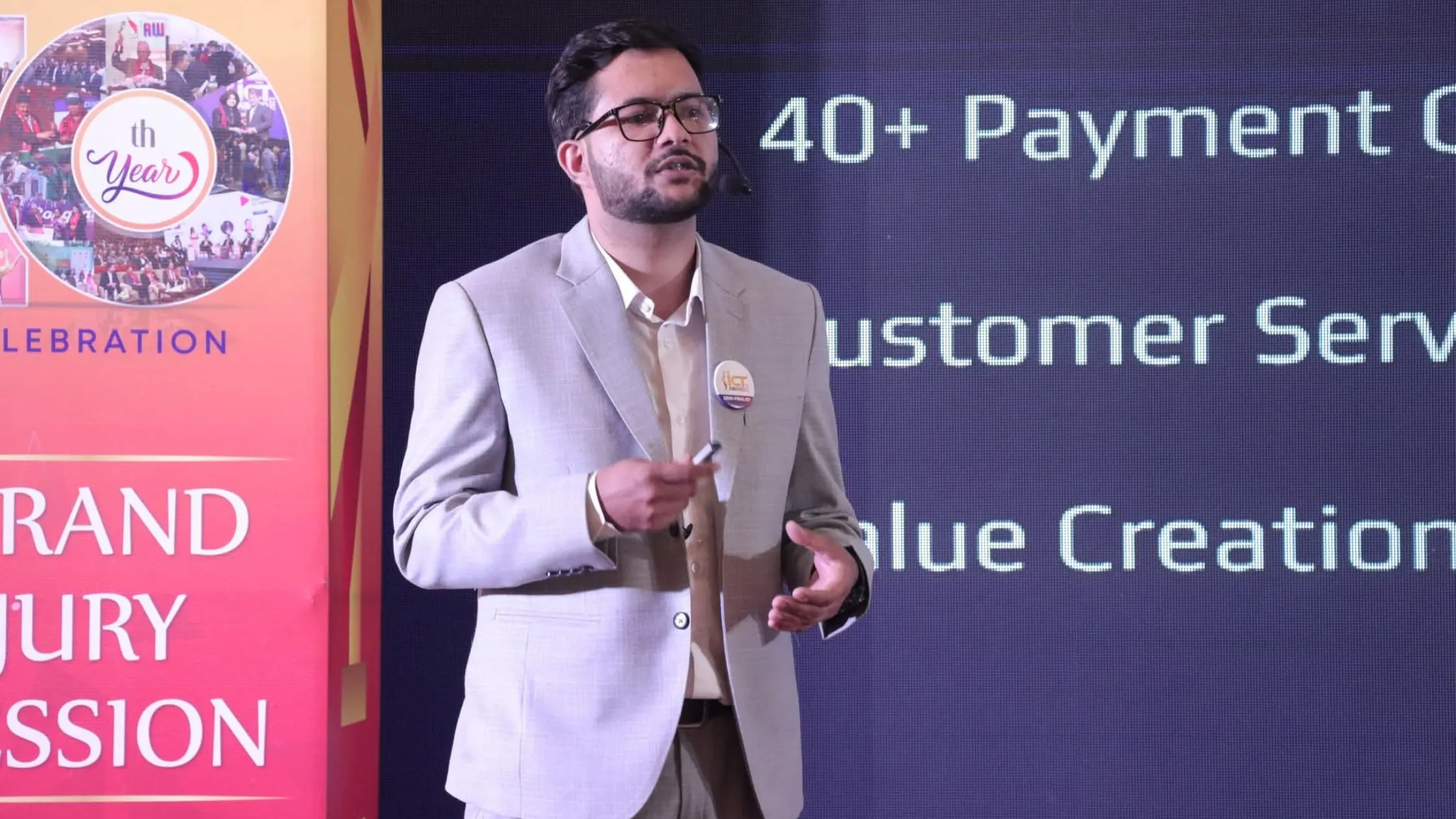
In April 2026, Trip Turbo crossed 500,000 downloads. In 2025 we won the ICT Award — People’s Choice. I stood on a stage and pitched to a panel of judges — something two years earlier I could not have imagined doing.
Read the full Trip Turbo growth story.
Why I Call Myself a Growth Strategist, Not Just a Digital Marketer
The distinction matters and I want to be specific about it — it is not just a title upgrade.
A digital marketer is a tactical executor focused primarily on the top of the funnel — awareness and acquisition — using specific channels like SEO, paid ads, and social media.
A growth strategist designs full-funnel strategies covering acquisition, activation, retention, and referral — aimed at sustainable, long-term business and revenue growth. The emphasis is on the system, not the individual channel.
When I look at what I actually did at NIFF, at Trip Turbo, and with my consulting clients — I was never just running channels. I was asking: what does this business actually need to grow? Where are users dropping off? What does the economics of acquisition look like at scale? Those are growth strategy questions, not channel execution questions.
The title is an accurate description of the work — not self-promotion.
January 1, 2026 — The Personal Brand Resolution
I had owned a personal website since 2017. But I was never truly active on it — it existed without being built.
On January 1, 2026, I made a resolution: I wanted to be seen. I had ten years of work, real results, real case studies, and a point of view on digital marketing in Nepal that no one else had — and almost no one outside my immediate network knew about any of it.
I got the domain bimalrp.com — the .com.np domain had limitations that were holding the brand back. I started building the site seriously: service pages, blog posts, tools for Nepali marketers, and a content architecture designed to rank on Google and be cited by AI tools. I became more deliberate on Facebook, Instagram, LinkedIn, and TikTok — not just posting, but teaching and sharing.
The goal was three things: to teach, to learn from the public conversation, and to get more eyeballs on work that had mostly been invisible. This blog post is part of that goal.
The One Thing That Actually Made the Difference
People ask what skill made the biggest difference in my career. My honest answer: it was not a skill. It was a disposition — curiosity. The habit of going deeper into everything rather than stopping at the surface.
When something in digital marketing did not make sense to me, I did not move on. I stayed with it until it did. When a new platform emerged, I built something on it to understand how it worked — not just read about it.
The specific skill that came from that curiosity: refusing to limit myself to one domain. Most digital marketers in Nepal specialise early — they become the Facebook Ads person or the SEO person. I deliberately stayed a generalist long enough to understand how everything connects. By the time I needed to build a full growth system at Trip Turbo, I had the context to design the whole architecture — not just execute one piece of it.
What I Would Tell Someone Starting Digital Marketing in Nepal Today
Learn every domain before you specialise in any. Video editing, graphic design, copywriting, WordPress, analytics, paid ads, SEO, social media strategy — all of it. Not because you will use all of it every day, but because you cannot understand how any one piece works without understanding how it connects to the others.
Build a project, not just a skill. The fastest way to learn digital marketing in Nepal is to create something real — not a theoretical exercise. Start a niche social media page, build a website on a topic you know, run a small ad campaign with NPR 2,000 of your own money. The Stock Market TikTok page forced me to learn content strategy, algorithm mechanics, design, audience psychology, and posting discipline all at once — by doing something real with real feedback.
Build your personal brand from day one. I waited too long. I had real results from 2017 onwards but did not start seriously building my public presence until 2026. That is ten years of proof of work sitting invisible on the internet. Start documenting now. The compound interest on a consistently built personal brand is extraordinary.
Stop thinking digital marketing is cheap and easy. This is the biggest misconception I have spent ten years correcting. Good digital marketing is strategy, data, creative judgment, and execution working together. The businesses that treat it seriously get serious results. The ones who treat it as an afterthought get afterthought results.
“The difference between a digital marketer and a growth strategist is not the title. It is the question you start with. A digital marketer asks: which channel should I use? A growth strategist asks: what does this business actually need to grow?”
The Nepal Market Misconceptions I Have Spent 10 Years Correcting
Digital marketing people are cheap.
The most persistent and damaging misconception in Nepal’s business ecosystem. Brands that treat digital marketing as a cost to minimise are the same ones wondering why nothing is growing. The brands investing in it properly are the ones pulling ahead.
Digital marketing is easy.
Running a Facebook boost is easy. Knowing why it generated zero leads — and what to actually do about it — requires analytical skill, real experience, and deep understanding of how Nepali consumer behaviour differs from global norms. The ease of the tool creates the illusion of ease in the discipline. They are not the same thing.
Offline marketing generates more leads in Nepal.
I hear this constantly. It usually comes from founders who ran a billboard campaign, got brand buzz, and concluded that offline beats digital. What they are measuring is brand recall from offline and lead volume from digital — two entirely different metrics. Offline assists. Digital converts. Both matter. But confusing the two leads to consistently wrong budget decisions.
Where Things Stand in 2026
Ten years in, I am doing the work I always wanted to do — building growth systems for Nepal brands that actually move the needle. Trip Turbo is at 500K+ downloads. bimalrp.com is finally being built the way it should have been years ago. The personal brand I should have invested in earlier is now getting the attention it deserves.
The work is not finished. It never is. The Nepal digital marketing landscape is changing faster than it ever has — AI, new platforms, new consumer behaviours, new tools. The curiosity that pulled me into this field is the same thing keeping me relevant in it.
If you are thinking about a career in digital marketing in Nepal, or you are a business owner trying to understand what real digital marketing looks like, or you have been building quietly for years and wondering whether it is time to be more visible — I hope this story is useful. The path is not straight. But it is there.
Want to work with me or follow the journey?
I work with Nepal founders, CEOs, and startups who want to build growth systems that actually deliver results — not just run campaigns. If that sounds like what you need, let’s talk.
Talk to Bimal about your marketing strategy
Further Reading
-
How Xtreme Energy Drink Conquered Nepal: A Full Marketing Breakdown
-
Go-to-Market Strategy for Nepali Startups: The Complete Founder’s Playbook
-
App Growth Strategy for Nepal — How to Get Your First 10,000 Downloads